WEEK 1
Lesson 1: Understanding the Vagus Nerve
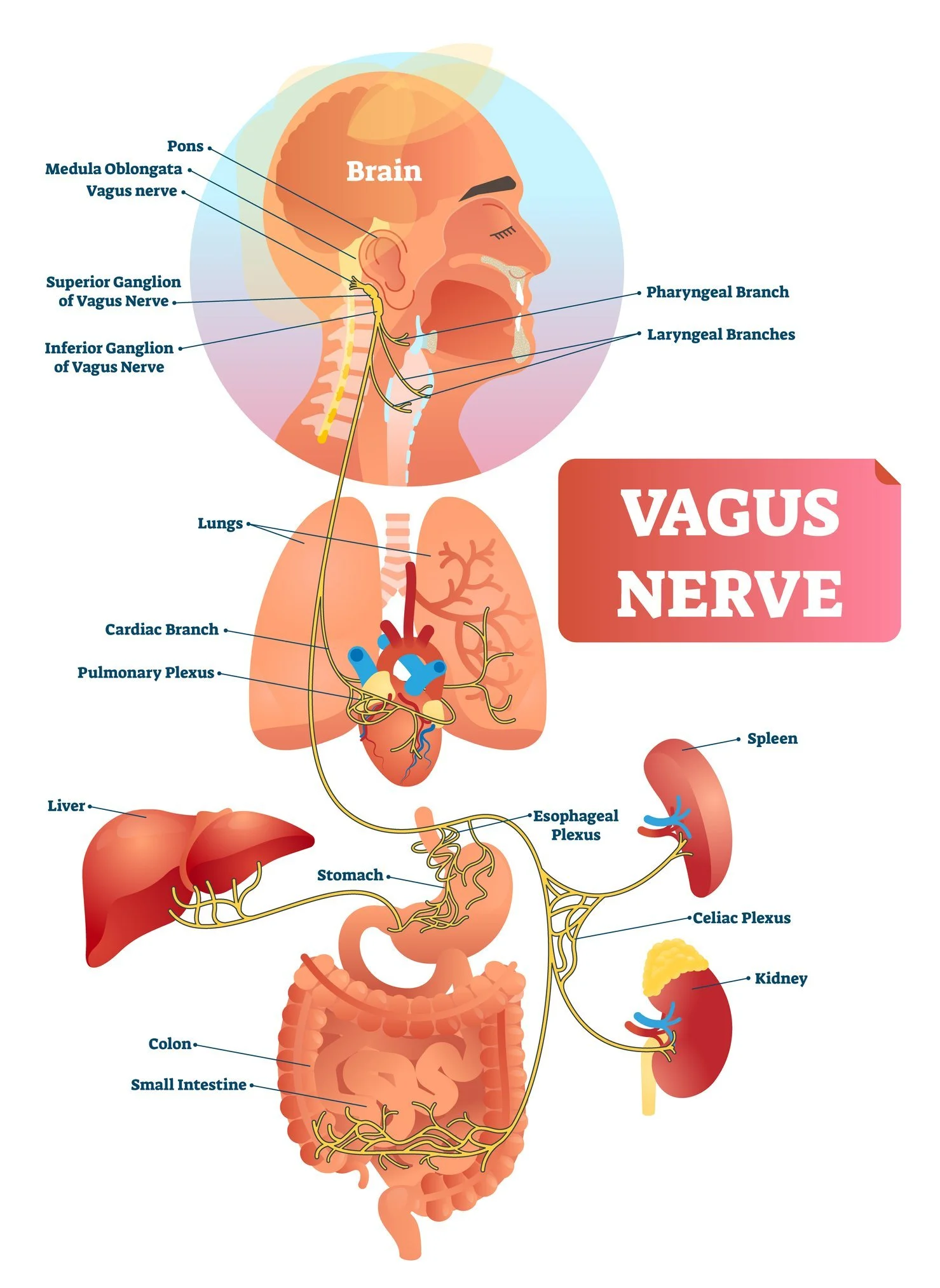
The vagus nerve—Latin for “wanderer”—is the longest cranial nerve in your body. It travels from your brain all the way down to your large intestine, connecting to nearly every major organ system.
It plays a central role in:
Heart rate
Breathing
Digestion
Mood and emotional regulation
The vagus nerve connects the gut and brain and communicates information from the gut to the brain using neurotransmitters, such as serotonin and glutamate, and gut hormones, all of which play a vital role in sleep, mood, pain, stress, and hunger. Meaning the vagal pathway is bidirectional with 80 percent of the information going from the body to the brain and 20 percent from the brain to the body.
The Gut-Brain Connection
The vagus nerve carries information between your body and brain.
80% of signals travel from the body to the brain
Only 20% go from brain to body
This means your body is constantly informing your brain, not the other way around.
Resma Menakem, the author of My Grandmother’s Hands, describes the vagus nerve as the soul nerve because it communicates between different parts of the body, and also from one person to another. Much of what we know about the vagus nerve was discovered in the past two decades, and there is undoubtedly much more than we need to learn.
One of the main functions of the vagus nerve is to receive fight, flight, or freeze messages from your brainstem ( reptilian brain) and help the rest of your body prepare to engage in a survival response. The same nerve is responsible for receiving and spreading the message that you are safe, so it can restore regular functions, and you can relax.
The connection of your vagus nerve to your brainstem bypasses the prefrontal cortex ( thinking brain). There is only one language the brainstem speaks: Am I safe, or am I unsafe?
Through your brainstem, your vagus nerve, and other cranial nerves responsible for senses like sight and hearing, scan both your internal and external environments for safety and danger.
With practice, you can consciously use your vagus nerve, as well as other cranial nerves, to settle your nervous system and body, which will help you avoid automatically sliding into a fight, flight, or freeze response in unnecessary situations.
OVERVIEW :
Your nervous system is always asking one question: “Am I safe?”
This happens through your brainstem (your survival brain), not your thinking mind.
Your vagus nerve helps:
Activate survival responses (fight, flight, freeze)
Or restore safety and calm (rest, digest, connect)
Guided Somatic Awareness
Place one hand at the base of your neck
With your opposite hand, gently trace down along the side of your neck, across your chest, and into your abdomen
Visualize a continuous pathway connecting these regions
Now:
Place one hand over your heart
The other over your abdomen
Notice the subtle communication between these areas.
Allow yourself to recognize the intelligence of this system and its role in maintaining your internal balance.
The Basic Vagus Nerve Exercise
This foundational practice supports:
Mobility of the upper cervical spine
Increased circulation to the brainstem
Activation of the parasympathetic (restorative) response
Instructions:
Lie on your back in a comfortable position
Interlace your fingers and place your hands behind your head
Allow your head to rest fully into your hands
Without moving your head, shift your gaze to the right using only your eyes
Hold this position for 30–60 seconds, or until you experience a swallow, sigh, or yawn
Return your gaze to center
Repeat on the left side
Before & After Observation
Slowly rotate your head to each side
Notice differences in range, tension, or ease
This practice is most effective when repeated consistently.
A simple way to integrate it is by pairing it with an existing daily habit like going to the bathroom , or your morning coffee.